Best way to buy and sell Ethereum via MyEtherWallet
buy and sell Ethereum via MyEtherWallet
Buying and selling Ethereum has never been more relevant in today’s crypto-driven economy. The key to safe transactions lies in selecting a reliable wallet. One of the most trusted tools is MyEtherWallet, a free, open-source interface for generating Ethereum wallets and managing assets built on the Ethereum blockchain.
Unlike many online exchanges that store funds on centralized servers, allows you to keep full control over your private keys. This ensures security while giving you the freedom to interact directly with the blockchain. For beginners who want to understand how wallets interact with blockchain platforms, check this beginner’s guide on cryptocurrency wallets.
In this updated article, we’ll walk through how to set up, purchase ETH through platforms like Coinbase, send tokens to your wallet, and even sell them securely. Whether you are new to Ethereum or seeking advanced tips, this guide provides the step-by-step clarity you need.
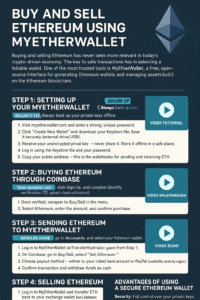

Step 1: Setting Up Your My EtherWallet
The journey starts with creating your wallet.
Visit myetherwallet.com and enter a strong, unique password.
Click “Create New Wallet” and download your Keystore file. Save it securely (external drive/USB).
Receive your unencrypted private key — never share it. Store it offline in a safe place.
Log in using the Keystore file and your password.
Copy your public address — this is the wallet address for sending and receiving ETH.
Security Tip: Always back up your private keys offline. Hackers target stored files on infected devices, so deleting traces after saving securely is a must.
Video Tutorial: How to Create and Secure MyEtherWallet
Step 2: Buying Ethereum Through Coinbase
Coinbase remains one of the most convenient platforms to purchase Ethereum:
Visit coinbase.com, click Sign Up, and complete identity verification (ID upload + bank/credit verification).
Once verified, navigate to Buy/Sell in the menu.
Select Ethereum, enter the amount, and confirm purchase.
Note: Bank transfers may take longer but come with lower fees compared to card payments.
Video Walkthrough: How to Buy Ethereum on Coinbase
Step 3: Sending Ethereum to MyEtherWallet
Once purchased, you should transfer ETH to your wallet for security:
Log in to Coinbase, go to Accounts, and select your Ethereum wallet.
Click Send and paste you address from Step 1.
Enter the amount to send (or “Use Max”) and confirm with 2FA authentication.
Wait a few minutes — the ETH will reflect in your EtherWallet.
This ensures your funds are secure and under your full control.
Detailed Guide: Transferring ETH to MyEtherWallet
Step 4: Selling Ethereum
Selling ETH can be done by reversing the process:
Log in to transfer ETH back to your exchange wallet (e.g., Coinbase).
On Coinbase, go to Buy/Sell, select “Sell Ethereum.”
Choose payout method — either to your linked bank account or PayPal (availability varies by region).
Confirm transaction and withdraw funds as cash.
This flexibility makes ETH highly liquid, whether you want fiat cash or to reinvest in other cryptocurrencies.
Video Demo: How to Sell Ethereum for Cash
Ethereum: A Quick Overview
Ethereum is more than just a currency — it is a decentralized blockchain network supporting smart contracts and dApps. Proposed by Vitalik Buterin in 2013 and launched in 2015, it quickly became the backbone of DeFi and Web3.
Initial Price (2015): $2
2017 Surge: Reached $400, growing by 3,700% in one year.
Current 2025 Value: Fluctuating but remains the second-largest cryptocurrency after Bitcoin.
For a technical perspective, check this article on AI-powered crypto strategies.
Advantages of Using a Secure Ethereum Wallet
Security: Full control over your private keys.
Compatibility: Works seamlessly with ERC-20 and ERC-721 tokens.
Flexibility: Supports integration with hardware wallets like Ledger and Trezor.
Transparency: Open-source technology trusted worldwide.
Compared to exchanges, a decentralized wallet ensures that you are the sole custodian of your assets, eliminating third-party risks.
Risks and Best Practices
Even with strong security, users must remain cautious when handling digital currencies:
Always verify website URLs to avoid phishing attempts.
Store private keys and seed phrases offline.
Use hardware wallets for large balances.
Avoid logging in through public Wi-Fi.
For broader safety tips, check this guide on crypto investment risks.
The Importance of Wallet Security in Crypto Transactions
Handling Ethereum or any other digital asset requires strong security measures. Centralized exchanges may simplify the process, but they remain high-profile targets for cyberattacks. A decentralized wallet provides direct ownership of keys, which is the strongest line of defense against online threats.
Best practices include:
Maintaining multiple backups of recovery phrases.
Using hardware wallets for substantial holdings.
Regularly updating software and devices.
Staying alert to malware and phishing attempts.
This proactive approach guarantees that as crypto adoption expands, your wealth remains protected.
Ethereum’s Role in the Future of Decentralized Finance (DeFi)
is more than just a cryptocurrency; it’s the foundation of decentralized finance. It powers thousands of smart contracts and decentralized applications (dApps) that offer services like lending, borrowing, staking, and yield farming without the need for banks.
Key advantages of Ethereum in DeFi:
Accessibility: Open to anyone with an internet connection.
Transparency: Every transaction is traceable on the blockchain.
Innovation: Developers continuously create cutting-edge tools on the network.
The rapid growth of DeFi underscores the importance of having reliable wallets and secure blockchain interfaces.
Common Mistakes to Avoid When Managing Ethereum
Beginners often fall into simple but costly errors:
Losing Private Keys – Without backups, assets can be lost forever.
Phishing Attacks – Fake sites can steal login data and funds.
Sending to Wrong Addresses – Crypto transactions are irreversible.
Ignoring Gas Fees – Miscalculations can delay or cancel transfers.
Avoiding these mistakes ensures smooth operations and strengthens confidence in digital asset management.
The Evolution of Ethereum Prices Over the Years
Ethereum’s price journey highlights its resilience:
2015: Launched at under $2.
2017: Surged past $400, capturing global attention.
2020–2021: DeFi and NFT boom pushed prices beyond $4,000.
2025: Continues to be the backbone of Web3, gaming platforms, and digital finance.
These fluctuations show why protecting assets in a secure wallet is crucial, regardless of the amount owned.
Why Ethereum Stands Out Among Cryptocurrencies
Unlike Bitcoin, which focuses on being a store of value, Ethereum is programmable money. It supports smart contracts, decentralized applications, and NFTs, making it one of the most versatile blockchains in existence.
Key strengths include:
Smart contract capabilities.
A robust global developer community.
Scalability upgrades like Ethereum 2.0.
Integration with NFTs and metaverse applications.
This unique role cements its status as the second-largest cryptocurrency by market capitalization.

FAQs on Ethereum Wallets
1. Do I need a wallet to buy Ethereum?
Yes, a secure wallet ensures you maintain control of your funds.
2. Can I sell Ethereum for cash?
Yes, by transferring ETH to an exchange and withdrawing to a bank or PayPal.
3. Which wallet is best for Ethereum?
Options include decentralized wallets and hardware solutions for maximum safety.
4. How do I check my Ethereum balance?
Use your public wallet address to view balances on blockchain explorers.
5. Should I sell Ethereum now?
This depends on personal investment strategies and market conditions.
6. Can I store other tokens besides ETH?
Yes, wallets compatible with ERC-20 or ERC-721 can manage multiple assets.
Conclusion: The Value of Secure Wallets in Ethereum Management
Effectively handling Ethereum means prioritizing both usability and security. A secure wallet provides transparency, flexibility, and full ownership — qualities that centralized exchanges cannot offer.
By following step-by-step guidance and adhering to best practices, both new investors and experienced traders can confidently navigate Ethereum transactions in 2025 and beyond.